


Fry recounts Team Canada camp

Shell Lake’s Brooklin Fry is looking back on a fantastic experience after the 15-year-old took part in Golf Canada’s junior team camp.
The reigning Saskatchewan junior girls and women’s amateur champion spent five days at Bear Mountain in Victoria, British Columbia last week at an invite only camp for the nation’s best junior golfers. Fry said the first two days included three hours of drills covering all shots before playing a round at the national training centre course. The camp concluded with a three-day mini tournament. Fry said the week was a great venture.
“It was a really great experience,” she told Golf Saskatchewan. “It was obviously a little tougher for me to get my game back because I haven’t touched my clubs since the Lobstick, but it was a really good experience and I had lots of fun.”
Fry shot rounds of 82, 85, and a stellar 76 on day three. She said Bear Mountain can seem like a daunting golf course.
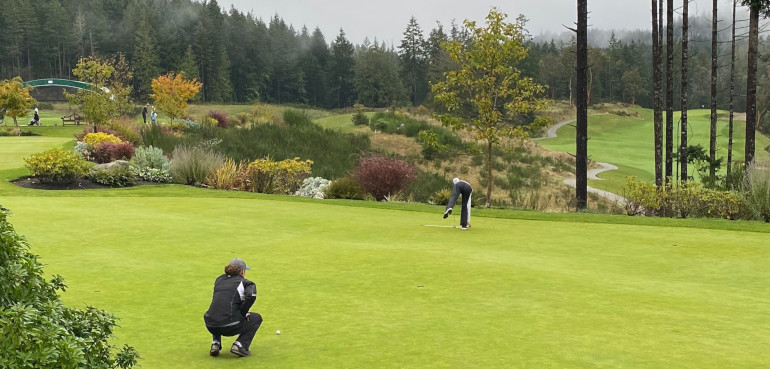
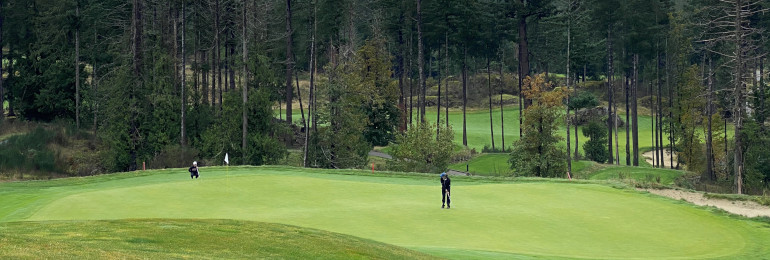
“Yeah, visually it was intimidating,” she said. “You had to play your shots perfectly.”
During the exit meetings the coaches praised Fry’s game and said she did well. She was also the second youngest player vying for a spot on the national junior girls’ team. Fry admitted she likely won’t be the first Saskatchewan player on the team since Jesse Gibson in 2010 but has a few years left of eligibility. Overall she said taking part in the camp was an amazing experience.
“There probably isn’t a word I could use to describe it. It was really cool to actually get invited,” she said.
Fry said the coaches will be reaching out soon to discuss the team in further details.
For now Fry will put down her clubs for a hockey stick preparing for her first season with the U18 AAA Prince Albert Bears that begin games in the first week of November.
Jennifer Greggain named coach of Golf Canada’s National Junior Squads

PGA of Canada member Jennifer Greggain has been named coach of the National Junior Squads by Golf Canada.
Working alongside head coach Robert Ratcliffe, Greggain will help guide mental performance, physiotherapy, biomechanics and nutrition for the Canada’s top athletes. Coaching will be based at the national training centre at Bear Mountain in Victoria, B.C., featuring a centralized component from March through June which provides accommodation and education for athletes during their high school second semester.
Greggain, a resident of Chilliwack, B.C., transitions into the role after joining the national team program as assistant coach of the Women’s Amateur and Young Pro Squads in January of 2020.

Prior to joining Golf Canada, Greggain was the director of instruction at Chilliwack Golf Club, the assistant coach for the University of the Fraser Valley, and led the B.C. Summer Games Squad on numerous occasions. Before her coaching career, she was an accomplished player for more than 10 years on the LPGA and Symetra Tours.
“Jennifer brings a strong background in competitive golf to compliment a wealth of coaching knowledge that will continue to fill the pipeline with high performance athletes,” said head coach Robert Ratcliffe.
She’s both TPI and K-Vest certified and last June she enrolled in the University of British Columbia’s Master of High Performance and Technical Leadership program. Greggain is the recipient of the 2018 PGA of Canada Jack McLaughlin Junior Leader of the Year.
The PGA of Canada Class ‘A’ member was also instrumental in guiding Golf Canada’s Women in Coaching program.
Greggain is a mother of two and lives in B.C. with her husband.
Golf community saddened by passing of former Golf Canada President Findlay Young

The Canadian golf community is saddened to learn of the passing of former Golf Canada President and Honorary Life Governor Findlay Young of Prince George, B.C., who passed away suddenly on Friday, October 9, 2020 at the age of 92.
Young was born in 1928 in Glasgow, Scotland, where he met his wife Nancy. They married in 1955 and emigrated to Canada in 1957.
He served as a director at B.C. Golf from 1961-1999 and was an honourary life director. He also served as president of the Royal Canadian Golf Association (now Golf Canada) in 1993 where he was also named an honourary life governor.
In total, Young won 53 golf competitions, including 11 Prince George Golf and Curling Club championships between 1959 and 1970. He recorded eight holes-in-one.
Among his many accomplishments off the golf course, Young was a director for the Prince George Mohawks senior hockey team for 10 years and was inducted into the Prince George Sports Hall of Fame in 1998.
For many in the golf community, Findlay was a great friend and mentor whose passion for golf and contributions to the game left a lasting impact. His mark on our organization and our sport will not soon be forgotten.
Below is a message that was shared by the Prince George Golf & Curling Club and here is a link to the bio that was included with his induction into the Prince George Sports Hall of Fame.
Always prioritizing junior golf, he successfully mentored many skilled amateurs locally, provincially, and nationally, including captaining the Pacific Northwest and Canadian Junior Teams. Findlay’s rules proficiency and diplomatic skills eventually led to the presidency of Golf Canada as the first ever elected from Northern BC.
As president he attended the World rules conference and served as Canada’s golf ambassador to the 1994 Masters and Canadian, U.S., and British Opens. A lethal wedge player and scratch golfer for many years, Findlay dominated golf in the Northern interior, holding 11 club championships at the Prince George Golf & Country Club, a record that will never be equaled.
“Fin” significantly influenced all aspects of our club’s development, and on behalf of the board, our condolences and best wishes go out to the Young family.
“scíth a ligean”
Respectfully,
Don McDermid
General Manager On Behalf of the Prince George Golf and Country Club Board of Directors
Kutcher hunts down top-3 finish at MJT Nationals

Regina’s Hunter Kutcher has a bronze medal from the Maple Leaf Junior Tour (MJT) Nationals last weekend.
Kutcher, 16, started playing golf at Madge Lake Golf Course after a family friend “built” him a golf club, problem was it was right-handed. Kutcher is a lefty. The Regina product eventually got a set of clubs. He became a member of the Royal Regina Golf Club at 12 years old and hasn’t looked back. He played his first MJT event the next year, he performed well and lit a fire for competitive golf.
“Yeah, it did,” Kutcher told Golf Saskatchewan. “I was really happy after that first tournament and how well I did. Man, if I work at this I could get pretty decent. I placed fifth in that tournament.”
Kutcher has since been a mainstay on the Saskatchewan MJT loop and the provincial championship. After respectable finishes in 2019 Kutcher was able to collect a couple top-5 finishes this past season. He said putting in work in the offseason was the key to his improved results.
“I was playing once a week at First Tee, sometimes twice a week. I did workouts at 1621 with Tanner White and I saw huge improvements with my strength and swing speed. That was a big part, with playing at First Tee, working on my swing and setting goals was a big thing as well. I set a lot of goals and I think I achieved all of them,” Kutcher said.
Kutcher’s season was noticed by the MJT organizers, so he received an invitation to attend their final event in Surrey, B.C. over the Thanksgiving weekend. Kutcher shot 79 and 78 in not so great conditions over the first two days. He posted a 71 on day three to jump up the leaderboard and earn a bronze medal. He said there wasn’t any expectations going into the event.
“I didn’t have any expectations, that was the biggest tournament I have ever played in. I put absolutely no pressure on myself. I went into it with the mindset, let’s play some golf, play your own game and have some fun,” he said.

After day two he was in eighth place and knew he had a low round in him on a “scoreable” course. He knew where he stood at the turn on day three and felt a podium finish was possible.
“On the range I was hitting it really good. I stepped up to the first tee and I was confident. I had that feeling that I was going to go low. I told my parents when I left clubhouse I have a low round in me. I went out there, I striped it up the fairway, I hit it onto the green, two putt par. I got rid of the nerves off the first hole and it was smooth sailing or the rest of the round,” he explained.
Kutcher ended up seven strokes behind the winner of the juvenile boy’s division. He said bringing home the bronze medal is still sinking in.
“I was in shock, going into the week I didn’t even expect to be top five. When I found out I was top three I was so happy. I don’t even know how to explain it. I was with my friend and he was so proud of me, that made me happy. I was just in shock,” he said.
Kutcher is a grade 11 student at Riffel High School in Regina. He will continue to work at the game and hopes college golf is in his future after he graduates in 2022.
MJT names Saskatchewan players of the year

The Maple Leaf Junior Golf Tour (MJT) has announced their players of the year across the nation including here in Saskatchewan.
Buena Vista’s Elias Haukeness is the peewee boy’s player of the year. Haukeness, 12, never finished lower than third in any Saskatchewan MJT event this season. He won the last three events he competed in as well. He said the season exceeded his expectations.
“I just wanted to beat my personal score in MJT, but I came out provincial player of the year which was a total shock to me,” Haukeness said. “Thank you to all the MJT people for keeping this competitive golf season going through the pandemic. It feels fantastic that I was named MJT provincial player of the year. I’m am very proud that all my hard work and dedication has gotten me where I am today.”
Haukeness placed second in his age group (under-13) at the Saskatchewan Junior Boy’s Championship and won the provincial Order of Merit (OMT) trophy for the same age group.
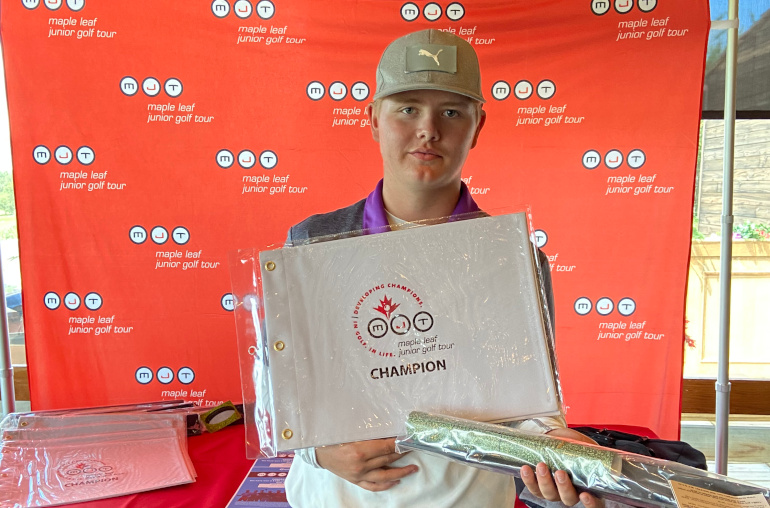
Weyburn’s Darien Herlick (above) had a great season earning the 14-year-old the bantam boy’s player of the year. Herlick won the first MJT event of the season in Swift Current. That was followed by a third-place result in Regina. A pair of second place finishes preceded a win in Warman in late August.
Herlick placed second in the provincial OMT race in the under-15 division.
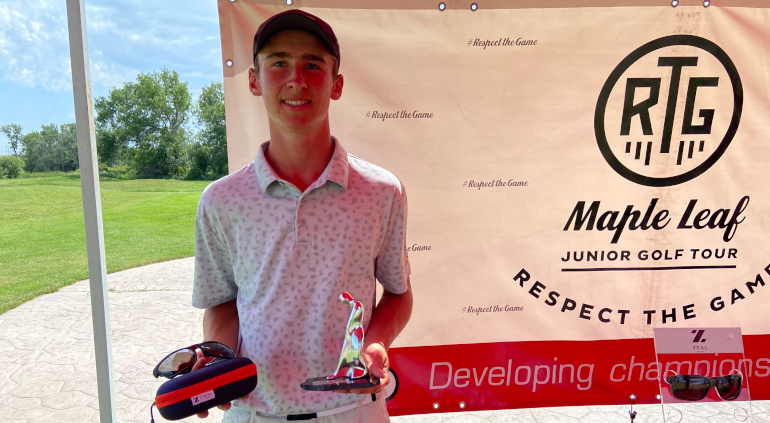
16-year-old Chase Pochylko (above) won his age group (juvenile, 15-16) twice this season on route to the division’s player of the year. The Saskatoon golfer picked up victories at Moon Lake Golf and Country Club and TS&M Woodlawn this past summer.
He finished in a tie for 6th at the provincial junior championships helping him place 6th in the OMT standings in the under-19 age group.
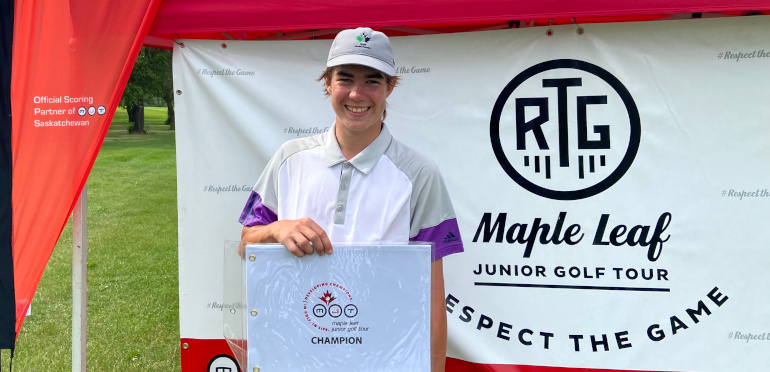
Theoren West (above) of Wawota enjoyed a breakout summer on the course. The 17-year-old Golf Kenosee player picked up two MJT wins and the MJT junior boy’s player of the year. West said winning a couple of events and climbing near the top of the junior field in the province were his goals going into the summer.
“I met my goals,” he said. “I wanted to be the best player in Saskatchewan and to win two tournaments which I did. That was my biggest goal for this year. It feels great, I worked really hard and that was one of my goals for the year was to be the best player in Saskatchewan by the end of the year so it was awesome.”
West placed 4th at the junior provincials and 3rd in the OMT standings.

Yorkton’s Ella Kozak (above) entered four events this year in the under-15 girl’s category and won all of them.
The victories made the 14-year-old Deer Park Golf Course member a shoe in for player of the year. She was victorious in MJT events in Swift Current, Regina, and Warman. She was also the under-15 provincial girls champion and the U-15 OMT winner.

Sarah Grieve had a busy season and a successful one. The 17-year-old Saskatoon golfer won the MJT 15 – 19 girls age group three different times, picked up a second along the way and is the 2020 player of the year. The Willows Golf Club member said her hard work paid off this summer.
“My goal this season was to lower my scoring average into the 70’s, so earning the 75.88 scoring average definitely exceeded my expectations. I worked hard to play my best golf as soon as the golf courses opened, so receiving this award was a big achievement. It feels great to win this award in my age group this year,” Grieve said.
She placed third at the junior provincials and won the under-19 girls OMT championship.
For more details on the awards visit the MJT website.
Andrew Penner reflects on sand green feature

Earlier this summer, Calgary based Golf Writer and Professional Andrew Penner visited southwest Saskatchewan for a feature on sand green courses.
Penner, originally from Manitoba has been to Saskatchewan countless times over the years, but was finally able to pen an article on the unique facilities sprinkled across the farm-laden land.
He joined Golf Saskatchewan Director of Communications, Clark Stork via Zoom to discuss the article and the stories behind the story.
Ian Leggatt named GM of St. George’s Golf & Country Club

TORONTO, ON – St. George’s Golf and Country Club welcomes Ian Leggatt as General Manager effective November 2, 2020. Leggatt comes to St. George’s from nearby Summit Golf Club, where he held the General Manager position.
Ian brings a unique background to the position as a former PGA Touring Professional, and winner of the 2002 Tucson Open. He has spent the last eight years leading a successful operation at Summit Golf Club. He is a proven leader with an established reputation and track record of translating his vision and passion for golf into meaningful cultural changes.
“We are very excited to welcome Ian to St. George’s,” said John Ciardullo, Chair of the Board. “The Board of Directors and Search Committee was unanimous in selecting Ian among highly qualified candidates from Canada, the United States, and Europe. Ian’s golf-centric background and his real vision for delivering an exceptional Member experience are precisely the skills and talents that will position St. George’s for long-term success in Canada and will elevate the Club’s international reputation.”
“It is an honour to be the General Manager of St. George’s Golf and Country Club. The Club’s iconic standing in Canadian golf, along with its global presence, truly excites me,“ says Leggatt. “It is the cultural presence of the game that differentiates great clubs from good ones. I look forward to enhancing the culture of golf at St. George’s and delivering a world-class golf experience.”
Leggatt’s November start date proves timely with St. George’s poised to host the 111th RBC Canadian Open in 2021 after the event was postponed in 2020 due to the ongoing global pandemic.
St. George’s Golf and Country Club was designed by Stanley Thompson in 1929 and is currently ranked #23 in the world by Golf Digest and is the highest Canadian rated 5-Star Platinum Club. The classically designed course has played host to the Senior PGA Tour, LPGA Peter Jackson/Du Maurier Classic on five occasions, and the Canadian Open in 1933, 1949, 1960, 1968, and 2010.
Four Sask. students receive Pat Fletcher Foundation funds

Four Saskatchewan students are recipients of the Pat Fletcher Foundation annual scholarships announced today by the organization.
The Pat Fletcher Foundation, whose purpose is to provide financial assistance to deserving young Canadian students on their journey to obtaining a university degree, announced the awarding of 25 new scholarships from across Canada.
“We are so proud of this year’s recipients. They demonstrated leadership and character
in their submissions, and we wish them the best of luck as they head back to university
and college this fall,” said Ted Fletcher, Founder and Chairman of Mint Green. “These
are outstanding young people – hard-working, well-rounded leaders in their
communities. They share our desire of “making a difference” and we are proud to have
played a small role in helping to shape their future.”
Carrot River’s Tenesha Pompu received the scholarship funds for the second straight year to assist her in her education endeavors at the University of Saskatchewan. U of S students Kylie Severson (Melville) and Landon Sosnowski (Prince Albert) were also named recipients. University of Alberta student from Wynyard Carson Fisher is the fourth benefactor in the province.
Since establishing the Foundation in 1985, The Pat Fletcher Foundation has awarded
543 scholarships, for a total of approximately $750,000 to young Canadian golfers –
giving them the opportunity to develop and reach their highest potential. The scholarship recipients include students from every province in Canada who go on to pursue their education at top schools both in Canada and the U.S.
“While my father was always very passionate about the sport of golf, he was equally
passionate about the importance of education. He took a genuine interest in working
with junior golfers to help them reach their full potential, both on and off the golf course,”
said Ted Fletcher, who continues to administer the Foundation, along with a board of
trustees.
The Foundation’s website, www.patfletcher.com includes the current list of recipients.
Autism Services of Saskatoon golf camp reaches 10 years

Saskatoon’s Jason Schneider began volunteering with Autism Services of Saskatoon for a class while attending university. 10 years later he’s still involved with the non-profit organization.
Upon receiving his PGA of Saskatchewan card in 2009 word got back to Autism Services and the two teamed up for an annual golf camp. Earlier this season the 10th season concluded.
“Since 2010 I’ve been running a four-week program,” Schneider explained to Golf Saskatchewan. “This year was a little bit smaller than usual due to some COVID-19 concerns. I’m so happy that we still got to run it for the few that were interested.”
Numbers were down this year as Schneider explained with three youth taking part in the month long, once a week program. Last year 10 participants took part. The numbers have fluctuated through out the decade, but Schneider said he sees lots of repeat attendees.
“The majority come and stay until they are unfortunately too old for the program. Lots continually come back, it’s great,” he said.
Schneider goes through three weeks of group lessons at Wildwoood Golf Club before him and employees from Autism Service take the participants out for a round of golf. Each day is celebrated with a drink in the clubhouse. He said the program stretches past the golf course.

“For lots of them this is the only time they do see golf, some are lucky and have parents that golf, so they’ve experienced it before. For lots it’s an opportunity to try something they typically wouldn’t have. A big part of any program through Autism Services is to try and work with them a little on communication and socializing skills,” Schneider said.
“It’s very rewarding and it’s very fun,” he concluded.
For more information on Autism Services of Saskatoon click here.
Men’s amateur champion back on collegiate course

2020 Saskatchewan men’s amateur champion Ty Campbell has competed in his first college golf tournament of the fall season.
The Saskatoon product and his Southern Wesleyan University Warrior teammates were at the Camden Country Club in South Carolina on Oct. 5 – 6 competing in the Camden Invitational. Campbell placed 27th overall in the 54-hole event shooting 12-over, 222 (73, 77, 72). Despite Campbell’s solid finish in the field of 68 players the Warriors as a team placed 11th overall.
Southern Wesleyan will host their own Classic on Oct. 13.
Kindersley’s Brody Istace was also on the course again this week south of the border.
Already with a top-five finish this season, the Music City Invitational at Twelve Stones Golf Club didn’t go as well for the junior Columbia International University (CIU) Ram junior. Istace carded rounds of 88 and 85 to finish in a tie for 64th. CIU placed 9th as a team in the 11-team tournament.
There is some positive news for the Rams as they have qualified for the NCCAA Championship in Palm Coast, Florida later this month. First the team will travel to Adairsville, Georgia for the AAC Fall Preview on Oct. 12 – 13.
Regina’s Jacob Kydd was also competing in the Music City Invitational for the Indiana Wesleyan University (IWU) Wildcats. The junior posted rounds of 84 and 80 for a 36-hole score of 20-over, 164. Kydd finished in a three-way tie for 56th. The team placed 6th overall.
Kydd has finishes of 12th, 17th, and 30th this fall season.
IWU is back on the course at their own Fall Invitational on Oct. 16 – 17.
Saskatoon’s Josh Nagy is in his second year at Robert Morris University near Pittsburgh. Nagy and the Colonials most recently played in the NKU Fall Classic in Lassing Point Kentucky. The two-time Saskatchewan junior boys champion finished in 68th place at 239 over 54 holes. The Colonials are competing at the Tom Tontimonia. Nagy is not in the field.
Several other Saskatchewan players are attending university south of the border, but schedules are postponed due to the pandemic. You can see more here.