


Conners off to strong start at Masters

AUGUSTA, Ga. – The last guy into the Masters left no doubt he deserved his spot.
Corey Conners followed up a thrill at the first tee – a greeting from Jack Nicklaus – with a 2-under 70 that put the Canadian in solid position after the opening round Thursday.
“I feel like I belong,” Conners said.
Playing in the first group of the day, he got a chance to watch Nicklaus and Gary Player hit the ceremonial tee shots that traditionally kick off the first major of the year. On his way back to the clubhouse after his one and only swing, the 79-year-old Nicklaus congratulated Conners on last weekend’s victory at the Valero Texas Open – the performance that got him into the Masters as the final entrant in the field.
“That felt pretty special,” Conners said. “It’s cool that that Jack Nicklaus knows who I am.”
The 27-year-old native of Listowel, Ont., endured a sluggish start, playing the front nine at 1 over. He was solid off the tee, but a little too cautious on the treacherous greens. Then in the middle of the back side, Conners made his move.
He rolled in back-to-back birdies at the 13th and 14th holes before making eagle at the par-5 15th.
After a booming drive left only 212 yards to the green at the bottom of the hill, Conners launched his approach over the water, the ball coming to a stop just 6 feet past the cup for barely more than a tap-in.
A three-putt bogey at the final hole put a bit of a damper on his day.
But Conners wasn’t complaining.
Not after his improbable journey just to claim a spot in the first major of the year.
Since he’s currently ranked outside the top 125 in the FedEx Cup, Conners had to go through Monday qualifying just to get into the Texas Open. He made a 20-foot birdie at No. 18 to sneak into a six-man playoff for the final berth in the actual tournament. Then, with a birdie at the first extra hole, he eliminated the other five contenders.
With a 10-birdie round on Sunday, Conners captured the first PGA Tour victory of his career – and an invite to Augusta.
Conners certainly understands the enormity of the odds of everything falling into place the way it has.
“Look, I’m a math and stats guy,” he said, standing near the giant magnolia tree that shades the porch of the stately clubhouse. “I know I was very unlikely to be here. I can say with certainly that I didn’t think I would be here, but it worked out very well.”
Conners is off to a much better start than his only other appearance in the Masters.
The fun continues! @coreconn holds the lead at #TheMasters ?? pic.twitter.com/1ENLpNAK7U
— Golf Canada (@GolfCanada) April 11, 2019
After qualifying as an amateur in 2015, he opened with an 80 that left him no real chance of making the cut.
Now, with another solid round, he’ll be heading on to the weekend for the first time.
He has plenty of fans cheering him on.
“There are way more Canadian people than I was expecting – or at least people pretending to be Canadians – out there,” Conners quipped. “It was awesome.”
Mike Weir, the 2003 Masters champion and the only other Canadian in the field, shot a 72.
Big Changes to Golf Rules for 2019

The golf season is about to tee off here in Moose Jaw this weekend and before you hit the links, you may want to brush up on the rules.
The Rules of Golf have undergone significant changes for the 2019 season after collaborative work between the sport’s governing bodies, the United States Golf Association and the R&A
“It’s the most significant change since 1984,” said Brian Lee, Executive Director of Golf Saskatchewan.
The rule book was trimmed down from 34 rules to 24. The changes were put in place to speed up the length of a round and also to make the game more accessible to the casual golfer.
Lee said they simply tweaked a lot of rules that were already in place.
“One of the most significant changes is going to be on the putting green where players are going to be able to putt with the flagstick in,” he said. “In the past, if your ball was on the putting green, the flagstick could not be in, but this year, it’s totally up to the player.”
The time that you have to search for your ball has been reduced from five minutes to three.
So far during the 2019 PGA Tour season, rounds have been about 15 minutes shorter with the new rules. Lee said that kind of change for local golf courses could be big.
“That could mean that the golf course could get an extra foursome out, which could impact their bottom line at the end of the year,” he said.
Players will no longer be penalized for an accidental double hit, for a ball accidentally moving while you’re searching for it or if the ball accidentally moves while on the putting surface.
“Also if you’re on the putting green, one thing you’ll hear people complain about is that it hit a spike mark, you’re now allowed to repair that before you putt,” said Lee
“There are no definitions anymore of a lateral hazard, water hazard, these are now known as penalty areas, whether they’re marked red or yellow, so similar to what it had been in previous years, but the options are now easier to understand.”
Some of the rule changes have been an adjustment for even the professionals with players receiving additional penalties in certain cases.
“Dropping the ball has been the most significant change to our game, it’s no longer standing erect at shoulder height, it’s now dropping from knee height,” said Lee. “At the LPGA Tour event last week, they had a player revert back to the old rule and she got an additional penalty.”
Lee added that the changes might add a bit of extra thought to a round at the start, but he feels they will be well received as players get used to them.
“Yes there’s going to be a learning curve, but if we give this 2-3 years, these will become the norm and we’ll think about why we didn’t do this 100 years ago,” he said.
Golfers in Moose Jaw will be able to get out on the course and test out the new rules this weekend as the Lynbrook Golf Club and Deer Ridge Golf Course will be opening up tee-to-green. The Hillcrest Golf Club has its opening day set for Monday.
Story courtesy Marc Smith/www.discovermoosejaw.com
Special Olympics champion providing golf tips online

Coming off a golf medal performance at the 2018 Special Olympics Games in Nova Scotia last August, Regina’s Taylor Carter wants to help his fellow competitors get the most out of their game.
Carter, 26, has launched a YouTube channel in collaboration with Special Olympics Saskatchewan promoting golf tips.
“I decided to do something with Special O,” Carter told Golf Saskatchewan. “The idea came from myself; I emailed the suggestion to them and Special Olympics wanted me to do the videos for them.”
Carter will provide content to the page on a weekly basis covering several areas of the game. He said he will provide tips on balance, grip, and the basics of equipment. He added that he’d also provide mental tips for other Special Olympics competitors. Carter has published three videos so far and hopes to develop his own game and skills too.
“I started the videos Monday, so I am kind of new to the whole thing but I’m hoping to get better over time, both at golf and the video production,” he said.
Carter’s debut video has been viewed over 130 times and in a week. He has 14 subscribers on the page in just a few days. He said overall the feedback has been positive.
“Yeah, it has been,” Carter beamed. “Some of my brother’s friends have said it’s really cool and they like it.”
Carter has a busy summer planned on the course as well, he will once again enter a Special Olympics event at the Evergreen in Nipawin on Father’s Day weekend. He will enter various tournaments in and around Regina as well this season.
Johnson puts up historic Southern Arkansas low

Kade Johnson continued his strong collegiate golf season this week shooting the lowest round in the history of Southern Arkanasas University’s Div. III golf program.
The Yorkton product carded a six-under, 65 during the second round of the Natural State Golf Classic on Tuesday. Johnson finished the 36-hole regular season finale tournament in third place shooting 136, two strokes off his second victory of the season.
Saskatoon’s Roman Timmerman finished in 23rd after posting a score of 150, plus-8.
As a school, the Muleriders tied for third at the event in Heber Springs, Arkansas. The GAC Championship is next for the school, that starts on Sunday.
Golf Sask. welcomes new board members, encouraging budget

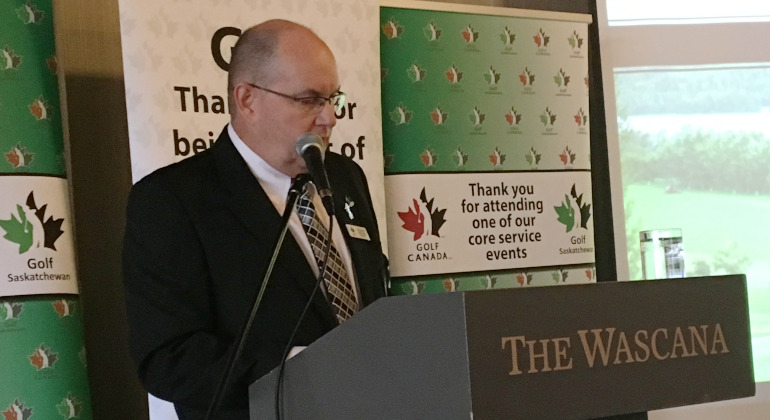
Golf Saskatchewan held their annual general meeting April 6 with positive news among the board of directors and finances.
33 people attended the event at the Wascana Golf and Country Club witnessing the organization’s audited report, message from the president as well as hearing from executive director Brian Lee. President Delbert Betnar said the meeting played out very well.
“We didn’t lose as much money as we’d hoped which is good, our goal is to get back into a non-deficient budget over the next two years.” Betnar said. “We’re going in the right direction. The fact Golf Canada to push out the membership plan and help the members here was a huge benefit.”
The organization expected to see a deficit of $85,000 but once the financial totals were calculated Golf Saskatchewan posted a deficit of $54,000. The organization is expected to be back on a balanced budget in two years. A large portion of the deficit is due to involvement at the CP Women’s Open in Regina.
The AGM included an election of new board members. Judy Sefton is the lone board member not returning to the executive. The Melfort resident is continuing to contribute to the sport. Betnar praised Sefton for her time and future endeavours.
“We’re going to miss her tremendously from a board perspective because she was a true asset,” Betner said. “At the same time, she’s going to help with Golf Canada and help out with our course rating so as a volunteer she’s still there.”
Danny Klugart and Diana Kerr have joined the board. Kerr brings experience in several volunteer positions, Klughard has played in Golf Saskatchewan championships for over 15 years. Betnar said bringing Kerr and Klughart on board is very beneficial.
“Getting that young experience and elite player aspect is good and getting Diana on, we get another female voice on the board which is good,” Betnar said.
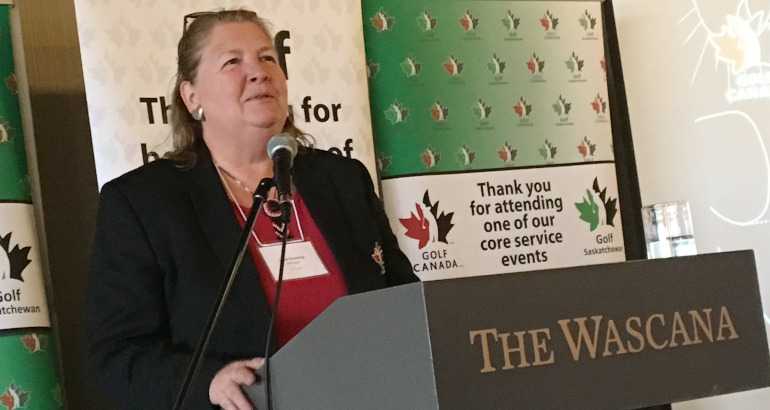
Betnar returns as president, Yorkton’s Don Kunkel is the vice-president, Todd Bergstresser returns as the treasurer. Nipawin based Kevin Duchscherer and Larry Wagman of Regina were successful in returning to the board.
‘The last year was an exciting year, this is going to be an exciting year too but in a little different way. Hopefully we grow on the CP Women’s Open,” Bednar said.

Canadian Corey Conners wins Valero days after qualifying, will play Masters

SAN ANTONIO – Canadian Corey Conners claimed his first PGA Tour victory and earned an invite to the Masters on Sunday, winning the Valero Texas Open less than a week after qualifying.
Conners only entered the tournament field Monday, and he’s the first golfer to win on the PGA Tour after qualifying on a Monday in nine years. He made three birdies in the final five holes, shooting a 6-under 66. He was 20-under for the tournament, winning by two shots over Charley Hoffman.
Next stop for Conners: Augusta, Georgia, for next week’s Masters.
Hoffman, the 2016 Texas Open winner, shot 67 for 18-under on the weekend.
Ryan Moore closed with an 8-under 64, a shot off the course record, and was third at 17-under.
Si Woo Kim, The Players Championship winner in 2017, led the opening three rounds but dropped to a tie for fourth with Brian Stuard (15-under) after an even-par 72.
Conners, the 2014 U.S. Amateur runner-up, will play in his second Masters. Two of the top three finishers last year at Augusta missed the top 10 this week. Rickie Fowler was tied for 17th while 10 strokes back at 10-under with a final-round 69, and Jordan Spieth (72) was 7-under.
Incredible performance from @coreconn. What a battle, and what a champion ??? pic.twitter.com/PnembdLq9q
— Golf Canada (@GolfCanada) April 7, 2019
Stuard finished with 66 to get to 15-under. Kevin Streelman closed with an 8-under 64 and was 14-under. He missed tying the course record when, after four-straight birdies, he hit his approach from the 18th fairway into the gallery and bogeyed.
Mackenzie Hughes (73) of Dundas, Ont., and Adam Svensson (70) of Surrey, B.C., tied for 42nd at 5 under. Nick Taylor (72) of Abbotsford, B.C., tied for 52nd at 4 under.
It was a wild round for Conners, a native of Listowel, Ont., who had not won on any of the PGA Tour’s affiliated circuits. He had 10 birdies and four pars that sandwiched four consecutive bogeys on the front nine.
He had a one-stroke lead when he rammed home a 34-foot birdie putt at No. 12, and stayed a stroke up with a tap-in birdie at the 14th.
Moore joined Conners at the top of the leaderboard with an 8-foot putt at No. 16 that was his fourth birdie in five holes.
Moore missed a birdie opportunity on the next hole when he couldn’t convert on a putt from inside 10 feet. Minutes later, Conners sank a 10-footer to save par at No. 15, then hit to four feet to set up a birdie at the 175-yard par-3 16th. His birdie at No. 17 gave him a three-shot lead walking up the final hole.
Conners looked like he would tuck this one away early. He birdied four of the first five holes at TPC San Antonio. Trailing by a shot going in the final round, he benefited from a three-stroke swing on the leaderboard on the third hole with a 10-foot putt on the par-3. Kim hit into the water fronting the green and double-bogeyed. Later in the day, Kim was grabbing at his right upper body with an apparent injury.
Conners was two strokes ahead, and with birdies on the next two holes he led by four over both Kim and Hoffman.
But Conners bogeyed the next four, and three of those came after tee shots put him in nice position either from the middle of the fairway or close to it.
The other bogey, on a par-3 at No. 7, he hit his tee shot into a bunker, then blasted over the green.
He made the turn and clicked off three consecutive birdies. The last player to qualify on Monday and win a PGA Tour event was Arjun Atwal in 2010 at the Wyndham Championship. That was the first time it had been done in 24 years.
Mclean commits to SAIT golf program

Deer Valley’s Carey Mclean will continue her golf career at the collegiate level.
Mclean, 17, has committed to play college golf for the SAIT Trojans of the Alberta Colleges Athletic Conference (ACAC) beginning next year. Mclean said she approached the Calgary based school while trying to plan her post-secondary education and SAIT checked all the boxes.
“I contacted SAIT and asked them if they had any golf opportunities and their coach, Stephen Yanitski emailed me back and said we’d love to meet you,” Mclean said. “We visited and I really liked the college. They seem more committed to helping you as a golfer. They have a better support system than the other colleges I looked at.”
The SAIT golf program returned to the ACAC in the fall of last year for the first time in two decades. The players, both ladies and men, compete in two regional events around Alberta. The conference also has a championship that leads to invites to the Canadian Collegiate Athletic Association National Championship. Mclean said she’s excited to have her scholarship opportunity locked up while still completing her high school.
“When I started golfing I never expected to play at this level. Getting a scholarship is exciting for me because I get to further my career and play golf, which I love,” she said.
Mclean competed for Team Saskatchewan at the junior women’s national championship last year and hopes to win the Saskatchewan juniors this upcoming season at Nipawin’s Evergreen Golf Course. She will also compete in the Saskatchewan Women’s Amateur Championship at Moon Lake Golf and Country Club in early July. Mclean is also a member of Saskatchewan’s High-Performance Program (HPP). She said the HPP was key in her development and post-secondary goals.
“For sure, Jason (Schneider, coach) works really hard to make sure we understand how we can improve our game and ourselves. He’s helped a lot with that. He checks in every week with us and makes sure we are doing what we need to do to better ourselves and our game,” she said.
Mclean plays several events across the Maple Leaf Junior Tour (MJT) as well in the summer. She said broadening her horizons and seeing more courses in another province and moving from home will be a great learning experience.
“I’m excited to be able to live away from home and see the different courses there are. Playing the usual courses, you get used to it. I want to try challenging myself and playing with people at a higher level,” Mclean said.
In the classroom she was hoping to take occupational therapy however there is a waiting list for that program. For her first two years she is going to study tourism and travel and potentially move into the four-year occupational department.
Kidsport to benefit from longest day of golf

An Estevan man is hoping to tee off 90 times June 22 while raising money for a worthy cause.
Brian Fitzpatrick, a member at the TS&M Woodlawn Golf Club is using one of the longest days of the year to play as much golf as he can while raising funds to get kids into sports that potentially don’t have the funds to do so. Fitzpatrick explains more.
“I am going to play from as early as I can see in the morning until I can’t see at night nonstop. I am going to try and get 90 holes in. I am raising money on gofundme for Kidsport Saskatchewan,” he said.
The official longest day of the year is June 21, but the Woodlawn is hosting a tournament that day, so the course was unavailable. Fitzpatrick said the following day is the next best thing and he will battle the elements and play through any less than ideal weather conditions.
Fitzpatrick said he has a goal of raising $1,500 that will hopefully help some kids get involved in a game they love.
“I chose Kidpsort, it’s a charity I really believe in. The ability for kids to play sports is everything. With all the sports they help with including golf, for kids that are less fortunate I feel this is a really good idea,” he said.
He is currently at $190 raised on the gofundme page. Fitzpatrick expects the donations to pick up once the Woodlawn opens for the season and he can help spread the word about the event.
He also said if anyone else wants to conduct a similar fundraiser at their club to reach out to him via email at bfitzy306@gmail.com. He said golf is a great way to be active and raise awareness for the Kidsport organization.
“Golf is number one for me, I used to be a hockey player but knee surgeries and a bad back makes it a little bit hard to play now, I pretty much focus on golf now.”
National Golf Day set for May 1, 2019

The Canadian golf industry represented by We Are Golf (formerly the National Allied Golf Association) has officially announced that May 1, 2019 has been tabbed as National Golf Day in Canada.
The date aligns with the We Are Golf initiative spearheaded out of the United States—also set for May 1, 2019—and will bring further attention to the game of golf and its significant community impact within not only Canada, but across North America.
We are Golf is comprised of all the national golf associations within Canada—Golf Canada, the Canadian Society of Club Managers, the Canadian Golf Superintendents Association, the PGA of Canada and the National Golf Course Owners Association Canada.

Planning for National Golf Day is underway with several activities to build upon the success of the inaugural 2018 event which included government advocacy and discussion with MPs in Ottawa, a public junior golf activity on the Parliament Hill lawn and various golf activities at clubs across Canada. The continuation of National Golf Day in Canada in 2019 will again incorporate meetings by We Are Golf stakeholders with MPs and government officials.
“We are looking forward to building upon the success of our 2018 National Golf Day and government advocacy efforts in Ottawa and continue to bring the positive value of the game of golf to the forefront,” said We Are Golf chair, Kathryn Wood. “National Golf Day will be a tremendous catalyst for golf enthusiasts to rally and celebrate what the sport of golf means to them and their community.”
Each member association representing We Are Golf is also encouraging their respective memberships, partners and stakeholders to participate in National Golf Day in their own way to celebrate the significant economic, health, recreational, charitable and tourism benefits that golf drives in communities from coast to coast.

We Are Golf is calling on the entire golf community as well as partner associations and golfers to engage in National Golf Day as a can’t miss event on the Canadian golf calendar.
Golf enthusiasts across Canada are encouraged to get involved in National Golf Day by playing a round of golf, visiting a course or practice facility, enjoying family time at the course, introducing a new player to the game, adopting a school in their community through Golf in Schools, hosting a school golf field trip, taking a lesson, or making a purchase at their local pro shop.
Please visit http://wearegolf.ca/ to learn more, and to access a social media toolkit to promote the day and get involved!
Golf in Canada – A Snapshot:
In Canada, more than five million golfers play close to 60 million rounds annually at nearly 2,300 golf facilities from coast to coast—the most participated sport in this country.
Golf is a significant economic driver generating more than $14.3 billion in economic impact and employing more than 300,000 jobs, nearly 40% of which are summer students. Direct revenues generated by golf courses and their facilities ($5.0 billion) rivals the revenues generated by all other participation sports and recreation facilities combined ($4.8 billion). Golf courses also steward essential greenspace in the community in addition to hosting more than 37,000 charity events that raise more than $533 million annually to support important causes.
The health benefits of moderate-intensity physical activity, burning 850 to 1,500 calories as well as muscle endurance, blood circulation, flexibility and mental health along with respiratory, metabolic and cardiovascular improvements can’t be discounted. Golf as a safe and inclusive family sport is good for our children, instilling etiquette and values such as integrity, honest, fair play and the spirit of camaraderie.
Do you know the changes coming to golf’s handicap system?
Old Man Winter is finally loosening his grip on golf courses across the country and many of you are already shaking off the rust of a Canadian winter and heading to the first tee, ready to post those scores for handicap purposes.
Good for you!
But did you know that those scores can only be posted in Canada during what is called the “Active Season” in your province?
While some lucky folks in more temperate climes (that’s you, British Columbia) can already post their scores, the rest of us have to wait until the middle of April or later.
From west to east, Active Seasons are: B.C., March 1-Nov. 15; Alberta, March 1-Oct. 31; Saskatchewan, Manitoba, Ontario, Quebec and Nova Scotia, April 15-Oct. 31; New Brunswick, May 1-Oct. 31; P.E.I., April 16-Nov. 14; Newfoundland and Labrador, May 1-Oct. 15.
Why is there such a thing as an “Active Season”?
“Active Season exists to help eliminate scores that might adversely affect the calculation of a handicap because they are generally not played under what we call `mid-season` playing conditions,” said Craig Loughry, Golf Canada’s representative on the World Handicap Committee.
“Generally, outside the Active Season, conditions are soggy, wet, lots of leaves (potential lost ball or bad lie), cool, etc., which makes the course play a little longer and different than mid-season (virtually little to no roll on tee shots, which means a loss per drive of about 20 yards. On an average course that has 14 driving holes, that could mean a 280-yard difference just on yardage alone.
“Greens are also much more receptive and generally slow compared to mid-season. It’s a combination of these things which distort how the course plays from which it was rated (we assume mid-season when the majority of rounds are played) and what the expected scores would be in optimum conditions, so we set an Active Season to help mitigate the effect of scores played in the shoulder season.”
While those dates aren’t likely to change in 2020, there will be a significant updating of the handicap system starting Jan. 1 when the new World Handicap System is implemented.

For the past four years, Loughry has represented Canada as Golf Canada’s representative on the World Handicap Committee, sitting beside the other major golf associations from around the globe in an effort to make the system more equitable, flexible, consistent and understandable.
Significantly, the committee—Loughry calls it “the United Nations of handicapping”—will meet in Toronto this fall, its first gathering ever outside the United States, Britain and Europe.
“We hope by informing golfers of the impending changes this far in advance, they will have the opportunity to review the changes and comment on them,” Loughry says.
A limit of net double bogey per hole will be allowed for handicapping purposes and the maximum Handicap Index will be set at 54.0, regardless of gender, to encourage more golfers to measure and track their performance to increase their enjoyment of the game.
Perhaps the most obvious change for Canadians is that the term “Handicap Factor” used in this country for years will become “Handicap Index” to align with the USGA terminology and which will be used worldwide. But the new system will adopt Canada’s practice of updating handicaps daily in all countries, as opposed to the current USGA model.
A list of 9 useful tips for the World Handicap System can be found here.
The committee’s research shows that your Index is unlikely to change significantly from your previous Factor. Only 54 holes worth of scores will be required for an initial Index and your Index will eventually be averaged using the best eight of your last 20 scores posted.
One very notable innovation is the Playing Conditions Calculation which “analyzes how players have performed that day compared to their expected performance on that golf course. It will naturally include weather and course setup (reflected in the scores) and if expected results fall outside a tolerance level, an adjustment will apply to all scores played on that course for that day.”
Have a look at the changes and take advantage of the opportunity to comment.
As for me, when the Active Season starts here in Ontario, I’ll already be posting scores via the Golf Canada app from South Carolina where the Active Season never ends. My snow blower’s broken.