


Easter Camp “super beneficial” according to two-time attendee

Golf Saskatchewan is once again offering their Easter Camp to junior golfers that will take them to Crown Isle Resort in Comox, British Columbia.
The program is back after a year hiatus and registration is now open to golfers 12 to 18 years of age and eligible to compete in either the provincial junior men’s or women’s championships. The camp runs from April 21 to 26. Chloe Sies, a two-time attendee said the camp helped develop her into a better player.
“It was nice, you would go at Easter and there is usually still snow on the ground in Saskatchewan and it’s cold. You have the itch to golf, you can go, and you are able to work on your game and get those first few rounds out of the way when you are rusty,” she said.
“I think the camp is super beneficial,” Sies added.
The camp includes five rounds at the Crown Isle Resort, where the attendees will stay. Crown Isle will be hosting a Web.com Tour event the following week, so course conditions are expected to be world class. The camp is designed to assist in the development of junior golfers, not only at the junior provincial championships this summer but overall. Sies said her experiences did exactly that.
“You learn a lot, there is drills and other aspects. You were learning drills that you could take back to your home course and work on even without a coach or professional.
PGA of Canada professionals attending the camp and providing coaching will be Steve Ryde and Jason Schneider. Ryde will be attending his first camp but has several years experience coaching junior golfers, Schneider has attended in the past including the years Sies was a participant. Sies is a past junior women’s provincial champion and was part of Team Sask’s amateur women’s team last year. She said taking part in the Easter Camp helped launch her to becoming one of the province’s best women golfers.
“I think so, it was about getting the early start and learning a lot from the two coaches and being able to bring that back home and play and put what you learn in action,” she said.
Aside from the five rounds on a world-class course the camp includes individual team challenges, confidence building development, and mental training. Included in the camp fee is transportation via air from Saskatoon, accommodations, and meals.
The deadline to register is March 15. Only 16 golfers will be allowed to attend. The application form can be downloaded here.
“It’s really fun, I still talk about stories we have from the trips,” Sies said. “You learn a lot, it definitely makes you better in the long run.”
Why learning the new Rules will set you up for success on the golf course

“It would not be a bad idea to require each golfer to pass a written examination on the Rules of Golf…”
Don’t panic. That was just the opinion of J.T. Clark, editor of the Toronto Star.
In 1915.
His comments were reported in Canadian Golfer magazine and the editor concluded the article with these timeless words: “Play up, play up, and play the game. And conscientiously observe the Rules and etiquette.”
Not much has changed since then. If anything, the recent renovation of the Rules of Golf, which went into effect on Jan. 1, has put a laser focus on the Rules and their implementation. (You can review the new Rules here.)
Recent incidents on the professional tours have impacted this greatly. Penalties for having a caddie helping line up a player and a disqualification for Sergio Garcia’s inexcusable behaviour at a European Tour event have garnered widespread and disparate reactions.
That, in my opinion, is not a bad thing. If anything, it’s positive.
Let’s take it for granted that many recreational golfers observe the mere minimum of the Rules and etiquette. That’s fine as long as they don’t impact the enjoyment and safety of their fellow golfers and they are not posting scores for an official handicap. Any score posted for handicap purposes must be played under the Rules of Golf.
Why?
In Clark’s words: “Players sometimes bring in weird scores, procured in weird ways that would disqualify them 10 times over.” Plus ca change, plus c’est la même chose, n’est pas?
But at the very least, every golfer, recreational and competitive, should have access to knowing and understanding the Rules.

While I’m not agreeing with Clark’s assertion that every golfer passes a written Rules exam, I think it is incumbent on anyone who is serious about the game to avail them of the opportunity offered by Golf Canada.
That’s my personal opinion, just like I feel every touring and club professional, golf coach at any level and the appropriate instructor at every Professional Golf Management program should be Rules certified.
If that isn’t the case, then ideally there would be a Rules expert (now called “referees” under the new Rules) at every course.
It’s an initiative that at least one provincial association is trying to encourage.
Anne Balser is the Manager of Sport Development and Championships at the Nova Scotia Golf Association. Aside from being an accomplished player (two-time Nova Scotia Amateur champion, 2010 Canadian University/College champion, four-time All-Canadian and twice an All-American while attending the University of Victoria), she learned the importance of the Rules at an early age. She recently obtained her national Rules certification.
“My mom was a golfer and a teacher, so any time my sisters and I went out with her, she took the opportunity to show us not only how the Rules worked, but how they could help us. I learned the Rules are not there to penalize you but that knowing the Rules can actually help you save strokes.”
This year, the NSGA is conducting introductory Rules seminars around the province. The first, at Ken-Wo Country Club, drew more than 70 golfers interested in learning the basics.
“It showed us that there is great interest among golfers to understand not only the new version of the Rules but how the average golfer can benefit from knowing the basic Rules,” said Balser.
In addition to these onsite visits, Balser pointed out that golfers can dig into the Rules while digging out of the snow before the season starts in much of Canada through various online opportunities such as webinars, YouTube videos and other supports.
Alison Murdoch, an honoured member of the Canadian Golf Hall of Fame with an incredible national and international resume, has been Rules-accredited at the national level for more than a decade. Her incentive to do so was obvious.
“As a player, it would be incredibly embarrassing to make a ruling for myself or another player and get it wrong, so I took it upon myself back in 2008 to take the Rules seminar and exam. I’ve never regretted it.”

(Photo by Andy Lyons/Getty Images)
She lauds the camaraderie of the Rules teams she is part of at tournaments, using compliments such as “welcoming, supportive, helpful, educational, rewarding, challenging” to encourage others to achieve their Rules certification.
“At my club, where they know I am a certified Rules referee, I am often asked about a ruling. It’s great to be recognized as a resource and I am happy to help. Perhaps the greatest reward is when I make a ruling and someone comes up to me after and thanks me because I saved them from an unfortunate situation because they were unaware of the Rule.”
Not only has the new Rules code become more understandable and user-friendly, but Golf Canada has changed their Rules Education System to three levels from the previous four to make it more accessible.
“Level 1 is an online platform to educate all golfers about the basics of the Rules and explain commonly encountered situations on the course,” says Adam Helmer, Golf Canada’s Director of Rules, Competitions and Amateur Status.
If you love the game, know the Rules.
Click here to register for Level 1.
From Wascana to the West Coast; Bernakevitch beaming in B.C.

Lindsay Bernakevitch has come a long way from the sandy greens of the Kelliher Golf and Country Club where he fell in love with the game that has taken him around the world.
The Regina product, and four-time Saskatchewan men’s amateur champion has made a career out of the sport and currently has one of the most marquee positions the nation could offer, Bernakevitch, 38, is the head professional at the prestigious Victoria Golf Club. Bernakevitch has been at the course for almost five years on the coast of the Pacific Ocean but he credits his start to Saskatchewan.
“I was the kid that my mom would drop me off at the course and I would stay there all day and she’d pick me up at the end of the day,” he told Golf Saskatchewan. “It was definitely a love affair with golf.”
As mentioned, Bernakevitch played plenty of golf in Kelliher growing up but frequented several courses in Regina as a youngster, mostly the Wascana Country Club which was near his family’s house in the Queen City. Bernakevitch’s father was, and still is an avid player. Bernakevitch played throughout high school and made several provincial junior teams before going on to college at the University of British Columbia and Western Washington. He said moving to B.C. and playing golf more frequently was important for his development. Bernakevitch said technology involving simulators and equipment is evening the landscape for golfers but climate is still the number one factor in improving your game but, it’s not the be all, end all.
“Try to get somewhere where there is a climate that’s going to be conducive to it, but also you don’t have to rush it,” he said. “You don’t have to be a superstar in high school, there is a lot of late bloomers in this game and obviously you see a lot of young guys on tour, but you also see old guys that compete out there. You don’t have to become a world beater over night.”
Bernakevitch speaks from experience when it comes to developing later in life, yes, he did have success as a junior golfer, but it wasn’t until his post-college days where the championships began piling up including in the Saskatchewan men’s amateur four straight years. His first of four wins came, fittingly, at the Wascana Country Club in Regina in 2000. Bernakevitch followed that with championships at the Saskatoon Golf and Country Club, Nipawin’s Evergreen Golf Course and the Riverside Country Club in Saskatoon. He said those tournaments helped vault him to an excellent career.
“The first one was almost a surprise, I loved golf and I was working hard for it and suddenly, I was like oh, I am better than I think I am. After the first one it became a driving force for me to do it again and that was a huge motivator for me to try and be the best,” Bernakevitch said.
Along with representing Saskatchewan on Willingdon Cup teams four times he played for Team Canada on several occasions and represented the nation at nine different international events over the years. Bernakevitch spent another five years playing professionally on the Canadian Tour but eventually wanted to settle into a career and “stop living from a suitcase.” Still wanting to stay in golf he chose the path of course management and head professional. Based on the advice from his mentor, Dave Wood, the current CEO of Shaughnessy Golf and Country Club in Vancouver, Bernakevitch began his career at that course as the backshop manager. He recalled the advice Wood passed along to him, “take the worst job at the best course.” He followed that path and eventually he landed the position in Victoria.
“Timing is everything, big jobs in Canada don’t come available all the time. For that I was in the right place at the right time. I was at a place in my career I could handle it and the job was available. To have those things go hand in hand were fortunate for sure,” Bernakevitch said.
He does count his blessings daily, growing up in Saskatchewan playing golf about five months per year doesn’t compare to the Victoria Club that closes one day per year, Christmas Day, but Bernakevitch credits his time in the province to allow him to be where he is today.
“Saskatchewan is a special place. Your members and readers know this but the people in the province are second to none, they’re the best that are out there. I still have a soft spot in my heart for the prairies,” he said.
Bernakevitch said proof of that statement was evident when Brooke Henderson won the CP Women’s Open at the Wascana this past summer. Although not at the event itself, Bernakevitch had returned to the Wascana just prior to the tournament to play during a family visit. He said witnessing the championship on television at his one-time home course was special.
“It was neat to see a championship being played on a course I was familiar with and obviously to have Brooke win was super special for Canadians everywhere. To see a Canadian win on home soil is always special,” he said.
Bernakevitch still finds time to play despite his busy career, he is coming off his second PGA of BC Club Professional Championship last September.
You can hear much more from Bernakevitch who spoke with Golf Saskatchewan`s Clark Stork this week.
A quick solution to golf’s pace of play problem

I’m the anti J.B. Holmes.
Don’t get me wrong. I’m not “anti” J.B. Holmes.
When he won the Genesis Open for his fifth PGA Tour victory, I applauded the resurgence of someone who, by most accounts, is a good guy, a great husband and father who has survived brain surgery. Former Ryder Cupper, long hitter, great ball striker.
Also, alas, human rain delay.
On the other hand, I am the definition of the “dew sweeper.” At my club, Midland Golf and Country Club in Ontario, my group is given the first tee time on Sundays by default, by a unanimous vote by the rest of the members. We play in three hours or less.
“Ready golf” is our mantra but we may take the pace of play concept to extremes, admittedly. Last season, someone in our group couldn’t make it and we had a friend fill in. After completing the first hole, he said he made a par 4.
“Nope,” I said. “In this group, we count practice swings as strokes. You took three, so that’s a seven.”
So, as I said, a touch extreme.
You want to talk about extreme?
In the final round at the Genesis, Holmes’s threesome needed—no, that’s wrong—endured five hours and 28 minutes to complete their 18 holes. Thirteen minutes on the 13th green alone. Twenty minutes behind the group in front. Professional golfers. Plumb-bobbing putts of less than a foot. (At least Holmes knew how to plumb bob. In my experience, most amateurs might as well close both eyes when they try that.)
At a time when it is widely acknowledged that one of the major challenges facing the game is pace of play, Holmes’s glacial approach deservedly lit up social media. Even his peers criticized him.
Taking my usual contrarian approach, perhaps Holmes should be applauded for elevating this debate.
None of us, except me, is exempt from this finger pointing.
At every level, from recreational golfer to the pro tours, slow play is a pernicious disease afflicting golf.
In 2018, the European Tour’s Shot Clock Masters addressed this by implementing a 40- or 50-second limit depending on the type of shot being played. Just four players received one-shot penalties for exceeding that limit. The reaction from the players was overwhelmingly positive.
“Rule 5.6b (3) lets a Committee set a specific pace of play policy,” says Adam Helmer, Golf Canada’s Director of Rules, Competitions and Amateur Status. “This policy may set a maximum time to complete a round, a hole or series of holes and a stroke, and it may set penalties for not following the Policy. The PGA Tour uses a hybrid of fines and penalties in their policy.
“Golf Canada adopts a group pace of play policy which outlines the allotted time for groups to play specific holes (1-5, 6-9, 10-14, 15-18). Groups are given warnings if they are over the allotted time and 14 minutes behind the group in front. If they miss a second checkpoint, they are liable to a one stroke penalty (and the penalty increases as they miss a third and potential fourth checkpoint). We only use individual pace of play at our qualifiers (Open and amateur events).”
I’m not advocating the kind of speed golf my group plays but if we—well, you all—paid more attention to pace of play, the game would be more enjoyable for everyone.
The new Rules recognize this through efforts like reducing the time allowed looking for a ball from five minutes to three and encouraging ready golf. What is ready golf?
Dispense with the “who’s away” concept. Hit when ready and when it is safe to do so. Prepare for your shot as you approach the ball. Have the appropriate club in hand. Putt out continuously. Mark your score at the next tee. Keep up with the group in front. Do your socializing after the round.
My well-learned lesson came years ago at Scotland’s North Berwick when our threesome, all male golfers of decent ability, let a foursome of lady members, with their bags on pull carts, play through. By the time we finished, they were enjoying a sandwich and a pint, accompanied by well-deserved withering glances in our direction.
I now enjoy directing those same glances at the pokey golfers at my club. Thanks, ladies.
Rule 5.6b advises that “A round of golf is meant to be played at a prompt pace. Each player should recognize that his or her pace of play is likely to affect how long it will take other players to play their rounds, including both those in the player’s own group and those in following groups.” The Rule also outlines pace of play recommendations.
Pace of play. It’s not about playing fast. It’s about playing efficiently and with consideration for others.
Golf among sports prominently featured in Sask. Sports Hall of Fame

Golf has its own Saskatchewan Hall of Fame that features over 50 inductees and a few teams, but the Saskatchewan Sports Hall of Fame (SSHOF) has honoured several prominent golfers as well.
Established in 1996, the SSHOF was developed to honour outstanding athletes, championship teams, builders of sport in the province and to archive the history of Saskatchewan sports. The inaugural class consisted of six individuals; Cal Bricker; Ethel Catherwood; Dr. George Genereux; Al Ritchie; James Trifunov; and Dorothy Walton. Although none of the distinguished members of the first class were honoured for golf prowess, as of today there are 10 individual golf standouts enshrined as well as two teams. SSHOF Communications Coordinator, Autumn McDowell said the inductees are recognizable to provincial golf fans and historians.
“Not only are these inductees’ incredible athletes but they have also done so much to grow the game of golf in the province. Golf Saskatchewan members will certainly recognize Joanne Goulet, the namesake for the Goulet Golf Course in Regina. The golf category also contains our only visually impaired inductee, Phil Lederhouse,” McDowell explained to Golf Saskatchewan.
Other golf inductees include Barbara (Stone) Turnbull; Geraldine (Evans) Street; James “Jim” Scissons; Tom Ross; Keith Rever; Dr. Robert Reid; Dr. John “Jack” Leddy; and Pat Fletcher. The two teams inducted are the 1992 Saskatchewan Senior Men’s Team (Fred Clark, Ray Marsh, Ron Corrins, Ron Whiteside) and the 1964 Saskatchewan Willingdon Cup Team (Alec Bland (the non-playing captain), Ernie Greenley, Ed Ross, Keith Rever, and Jim Scissons). More details can be found on all the inductees on the SSHOF website.
Former Lobstick winner Gordie Howe is also a member of the Hall. “Mr. Hockey” is clearly enshrined for his illustrious hockey career, but McDowell says the Floral, Sask. product, although the most well-known inductee is among over 500 well deserving recipients.
“Gordie Howe is probably our most famous inductee to the general public. However, there are very popular inductees in each sport, even superstars in each sport, but they just might not be as well known to the general public,” she said.
Members of the public are encouraged to nominate anyone they feel is worthy of induction. Nominations close annually on Oct. 31.
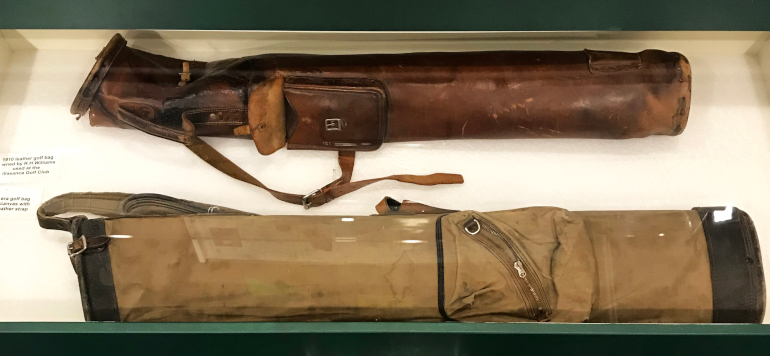
McDowell said golf enthusiasts will find a pair of displays interesting aside from the inductees themselves and their stories. The Hall has a 1910 golf bag (pictured below) used by R.H. Williams at the Wascana Country Club and the organization possesses a set of clubs (pictured above) that once belonged to Saskatchewan’s first Premier, Thomas Walter Scott.
Another popular exhibit currently displayed (pictured below) according to McDowell is, “Diamond Girls’ Diamond Anniversary: 75 Years of the All-American Girls Professional Baseball League. “In 2018 the All-American Girls Professional Baseball League (AAGPBL) celebrated their 75th anniversary. Over its eleven years of operation more than 600 women played professionally for the first time. Of those 600, 10 per cent were from Canada and 40 per cent were from Saskatchewan.
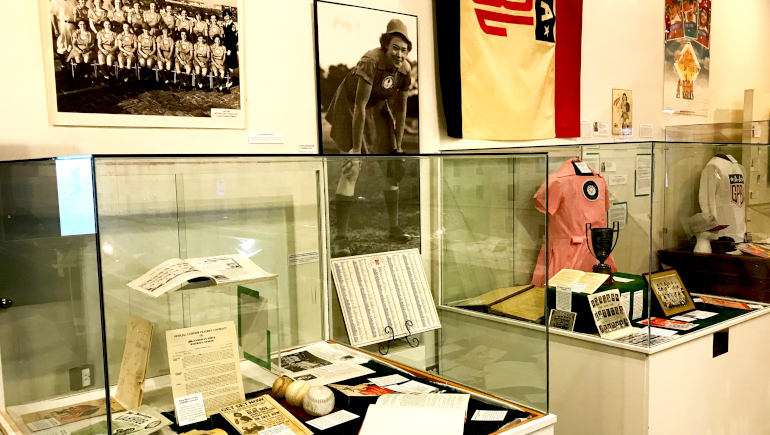
Golf Saskatchewan members receive free entry into the Hall at 2205 Victoria Ave. in Regina. The facility also includes a multi-sport simulator with an extensive golf feature. The Hall has clubs to use or attendees can bring their own.
The SSHOF is open Monday to Friday from 10 a.m. to 4:30 p.m. and 12 p.m. to 5 p.m. on Saturdays. Hours are extended during the third Thursday of every month.
Tours are also available by calling 306.780.9232.
High-Performance Program in full swing

Golf Saskatchewan’s High-Performance Program (HPP) is busy preparing a handful of young golfers to succeed with their goals.
Carey McLean (Deer Valley), Cole Jenkins (Prince Albert), Jackson Wingert (Saskatoon), Autumn Neiszner (Regina), and Max Regier (Saskatoon) are the junior golfers involved in the program this year. During the first two Sundays of February, the players met with coaches Jason Schneider and Steve Ryde at facilities in both Warman and Regina. McLean, 17, is back in the HPP for the second straight year. She said golf has provided several opportunities to travel and meet new people. McLean hopes taking part in the HPP elevates her game to pursue more highlights.
“I never thought I would be able to go to national championships with golf, I thought I’d just play the sport for fun. I never thought I’d be able to get a scholarship or go to Phoenix and play for Saskatchewan,” she said.

Through the first two sessions the players worked on goal setting, shot visualization, putting and full swing, plus their nutrition and physical training. Tanner White, the general manager at Regina’s 1621 worked with the group, sports mental trainer Lisa Hoffart was also involved. McLean said having a sports psychologist work with her is important for her game.
“My mental part of the game isn’t that good, getting one on one with Lisa helped me last year to get out of my head and focus on my game and not the outcome,” she said.
McLean starting golfing under her dad’s guidance at Deer Valley and over time developed a passion for the sport. She attended the Canadian Junior Women’s Championship last year as part of Team Saskatchewan and hopes to return to the national tournament as she enters her last year of juniors. Her goal is to reach the next level and play college golf following graduation. She said the HPP is a key cog in her future plans.
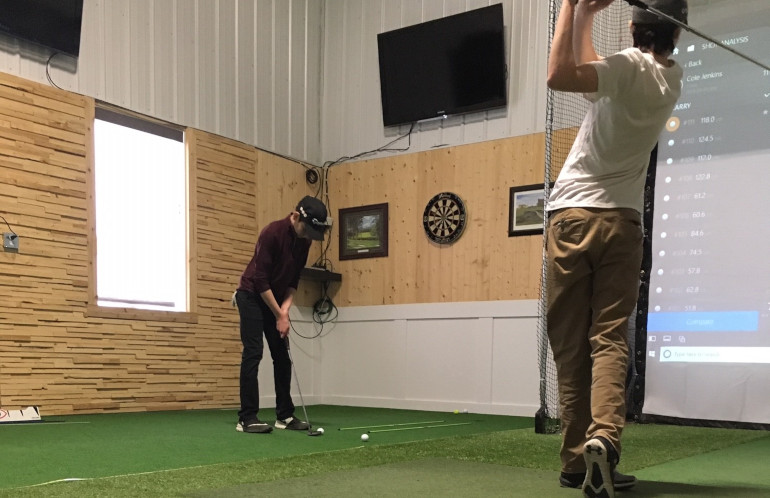
Jason Schneider has been involved in coaching the HPP for three years. He said without partners such as 1621, First Tee, and the Legends (Darryl Czuy), providing top notch programming would be harder to come by and he’s thankful for the assistance.
“Tanner and I work well together with what we want to focus on, and we have fun with the athletes,” he said. “Lisa definitely improves their mental game too as we go forward.”
The athletes will take part in two more training sessions before the golf season begins an April. There is also a two-day camp scheduled in Regina mid-May where more, on-course learning will take place. The coaches will also work with the students throughout the summer as well, preparing them for events and tournaments leading up to the provincial championships. Schneider said they approach each student differently preparing them for unique goals.
“There is a good mixture this year, we have a few younger ones, and we have a couple that are older. We’re hoping Carey and Cole can continue to develop their skills. For the younger ones we want to help them develop, have fun on the golf course, learn what competitive golf is like and have them ready for when it counts,” he said.
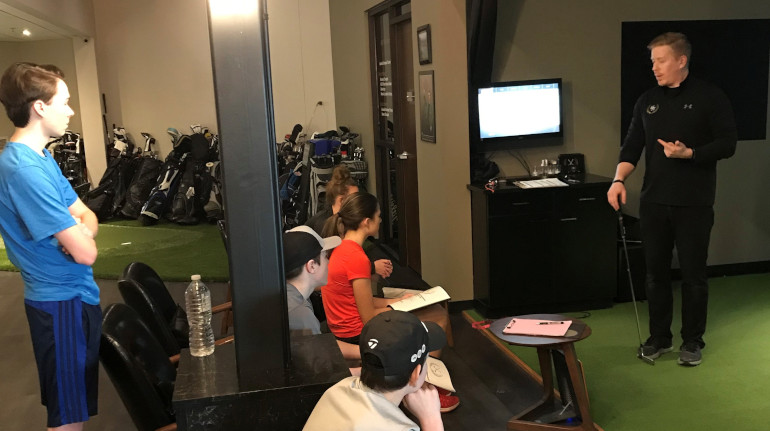
Steve Ryde coached the junior women’s team this past summer at the national event in Vancouver. He is also the Golf Saskatchewan Manager of Sport Development. He said providing the HPP through the provincial governing body has several benefits to up and coming golfers in the province.
“We want to promote an idea of hard work and dedication towards golf and improving golfer’s abilities in Saskatchewan,” Ryde said. “It’s an opportunity for younger athletes who may not have a coach yet and want to improve. We want to have kids compete and do well and ultimately get to the national stage where they will be recognized for scholarships and other opportunities down the road.”
R&A’s Women in Golf Charter showing success in Canada & worldwide

The R&A’s drive to increase the number of women and girls participating in golf and to encourage more opportunities for women to work within the sport has been reflected in early success for the new Women in Golf Charter.
Launched last May in London, the Charter set out to inspire an industry-wide commitment to developing a more inclusive culture within golf globally. It is designed to encourage actions that enable more women and girls to flourish and maximise their potential within the golf industry at all levels.
To date, 107 organisations have given their commitment to the Charter, pledging to build on current initiatives and develop new projects to increase the number of women, girls and families playing golf and becoming members of clubs, as well as giving women wider opportunities to enjoy careers and volunteering in the sport.
These include national federations such as Golf Canada – which held its inaugural Women’s Leadership Summit last year linked to the staging of the CP Women’s Open and enters its sixth year of hosting the World Junior Girls Championship, which welcomes athletes from 19 countries around the world.

Other organisations who have adopted the Charter include the PGA TOUR; the European Tour; the Ladies’ European Tour; the Professional Golfers’ Association; the Golf Foundation; the PGAs of Europe; the European Disabled Golf Association; the ANNIKA Foundation; IMG; VisitScotland and the All-Party Parliamentary Group for Golf.
Mastercard, the official card of The Open, is also the first R&A Patron to sign up. Various other organisations offering their support include the Association of Golf Writers and GOLFNOW.
Martin Slumbers, Chief Executive of The R&A, said, “We are encouraged by the number of organisations who have recognised the importance of the Charter for the sport and pledged their support.
“It is a positive start but we need an industry-wide commitment to the Charter and support for measures that will foster a more inclusive culture within the sport and enable women and girls to reach their full potential.”

While achieving the commitment of national federations and organisations was one of the first aims of the Charter, the process for clubs and regional bodies to sign up is also now gathering pace.
Conwy, which will stage the 2020 Curtis Cup in Wales, is the first golf club to sign up to the Charter.
Boldon, based in Tyne & Wear, is the first English club to sign, followed by commitments from Open venues Royal Portrush, St Andrews Links Trust and Carnoustie Golf Links.
Fulford, venue for the Girls Under 16 Amateur Championship, has also committed, along with The Royal & Ancient Golf Club of St Andrews, Blairgowrie, North Berwick and Royal Dornoch.
“Gaining the support of national associations and organisations was the first phase of our plan,” added Slumbers. “We have also worked closely with them to collectively agree a process to support individual clubs in adopting the Charter and gain real momentum.
“The national body is the point of contact and will directly liaise with clubs in determining commitments to the Charter should a club wish to become a signatory.
“We would like national associations, with the involvement of clubs, to set targets for participation and membership as we look to increase the number of women, girls and families playing the sport.”

2018 World Junior Girls Championship (Camelot Golf and Country Club, Cumberland ON)
Top-5 finish for Saskatoon’s Young

Anna Young is celebrating a top-5 finish in a tournament this week in Zellwood, Florida.
The Saskatoon product recently competed in an LPGA of Taiwan event but is happy to be back on North American soil. Young, 25, finished in a tie for fifth in the Zellwood Station tournament, a stop on the National Women’s Golf Association tour.
The five-time Saskatchewan amateur women’s champion fired rounds of 68, 71, and 70 to finish at seven under par, five strokes back of winner Greta Voelker. Young said she’s happy to be settled back into a routine to start the season.
“It has been nice being back in my routine here in Orlando, getting back on one time zone, going to my gym, and sleeping in my own bed. I felt like I did everything pretty well this week, nothing amazing and nothing terrible. My main focus was staying in the present and I did that well,” she said after the event concluded Wednesday.
Fellow Canadian Valerie Tanguay also finished in a tie for fifth at the event.
You can see Young’s scorecard here.
Tourism Saskatchewan offers multiple marketing opportunities for golf

Most golf clubs in Saskatchewan have websites and use the internet to their advantage when it comes to advertising and marketing their facilities, but most won’t realize they are missing out on potentially 1.5 million more customers.
Tourism Saskatchewan offers free business listing opportunities on their website to promote the province’s tourist attractions, including golf clubs. The TourismSaskatchewan.com website receives over 1.5 million unique visits annually.
Economically speaking, in 2017, Saskatchewan saw 4.8 million overnight visits generating $984 million in spending. Of those totals, 283,000 visits involved golf as an activity. Tourism Saskatchewan Manager of Marketing, Amy McInnis said the province’s abundance of lakes draws people to Saskatchewan, and golf is a factor for visitors.
“A large draw, especially for Albertans, is camping, summer products, those types of experiences. They are drawn to the lakes; they don’t have the abundance of lakes that we do, and they are likely to include golfing into as part of the overall experience. If they are coming to camp for a week in Prince Albert National Park, they are likely to pursue golf opportunities if they are interested,” McInnis explained.
Of the overall economic impact of $984 million, $71.7 million involved the game of golf. Golf Saskatchewan and Tourism Saskatchewan believes those numbers can grow with potential collaboration between member clubs and the use of Tourism Saskatchewan’s website. McInnis said tourist attractions have seen benefits over the years by utilizing their site.
“A lot of our advertising pushes to the website, as our website is central to everything we do,” she said. “It gets a lot of eyeballs, so it benefits members to participate. Everything is free, the listings are free, the travel offers are free.”
There is also an industry website (Industry.TourismSaskatchewan.com) that offers tips on how to brand your tourist attraction to align with the tourism brand for the province. The three brand categories are Land and Sky; Time and Space; and Community. The website also provides “Top 5 Tips” for improving their business or facility through marketing, photography tips, and digital marketing.
The consumer website, TourismSaskatchewan.com, features free business listings for operators that allow up to eight photographs. Tourism Saskatchewan Manager of Communications, Elizabeth Braitenbach, said they encourage golf clubs to reach out to them and use the site to enhance visitors.
“We are actively wanting and searching for more travel offers,” she said. “We call them travel offers because it can be a variety of things, they aren’t necessarily a vacation package per say. For golf it works really well with stay and plays, but a variety of offers could be put together that involve golf.”
Another feature Tourism Saskatchewan offers is a Co-operative Advertising Program (CAP). According to Tourism Saskatchewan Events Manager, Tyler Lloyd, all public golf courses in Saskatchewan would be eligible to apply for the program. Successful CAP applicants may receive up to 50 per cent cost sharing of advertising. Individual golf courses can utilize the program, however, Lloyd suggests teaming up as a region could be a more impactful route to promote courses.
“Partnering up like that is probably more strategic and would likely rank higher with adjudication,” he said. “There is limited funding there, but it is an application based adjudicated process. All public courses are absolutely eligible to apply, and if there are some that want to cluster together, that would be very effective.”
There is some urgency involved to benefit from CAP as the deadline to apply is February 28. Contact Tyler at 306-787-5525 or by email at tyler.lloyd@tourismsask.com.
To place your free business listing on the TourismSaskatchewan.com website, phone toll-free 1-877-237-2273 or email information.updates@tourismsask.com.
To place a Travel Offer on the TourismSaskatchewan.com website, contact Belva Schlosser at 306-787-5488 or email belva.schlosser@tourismsask.com.
Tourism Saskatchewan also provides funding for tourism operators to attend tradeshows or conferences that align with the Saskatchewan tourism organizations strategy. For more information on that initiative, contact Amy McInnis at 306-787-2199 or amy.mcinnis@tourismsask.com.
Golf Canada releases 2019 championship schedule

Golf Canada is pleased to announce its 2019 championship schedule, which includes a record setting 31 amateur and professional competitions in addition to various qualifiers hosted at golf facilities across Canada.
The 2019 schedule is headlined by Golf Canada’s premier professional championships — the RBC Canadian Open, June 3-9 at Hamilton Golf & Country Club in Hamilton, Ont., and the CP Women’s Open, to be conducted August 19-25 at Magna Golf Club in Aurora, Ont.
The 2019 competition calendar includes eight national amateur championships, eight Future Links, driven by Acura regional junior competitions and two international women’s championships.
As the National Sport Federation and governing body of golf in Canada, Golf Canada conducts the country’s premier amateur and professional golf championships as part of its mandate to support the development of the nation’s top talent through world-class competition.
“Golf Canada is incredibly proud to conduct our national championships for the more than 3,000 talented Canadian and international golfers who take part in our competitions,” said Golf Canada’s CEO, Laurence Applebaum. “Together with our host clubs, communities, volunteers and corporate partners, we are excited to be welcoming the next chapter of Canadian golf champions.”
Golf Canada’s championship season kicks off May 6 with the RBC Canadian Open British Columbia Qualifier and concludes in September with the Future Links, driven by Acura Fall Series Championship at Crown Isle Resort & Golf Community in Courtenay, B.C.
To view Golf Canada’s 2019 championship schedule including all host venues, registration requirements and volunteer opportunities please click here.
Championship Season at a Glance…
The 115th playing of the Canadian Men’s Amateur Championship will be contested at Glen Arbour Golf Course in Hammonds Plains, N.S. and The Links at Brunello in Timberlea, N.S., August 3-8. A field of 240 players will be cut to the low 70 players and ties after 36 holes, with the final two rounds contested at Glen Arbour. The champion will receive an exemption into the 2020 RBC Canadian Open, as well as an invitation to the 2019 U.S. Amateur Championship. Additionally, the winner will receive an exemption into local qualifying for the 2020 U.S. Open, and if applicable, the U.S. Junior, U.S. Mid-Amateur or USGA Senior Amateur Championships.
The 106th Canadian Women’s Amateur Championship takes place July 22-26 at Red Deer Golf & Country Club in Red Deer, Alta. with the champion earning an exemption into the 2019 CP Women’s Open, as well as an exemption into the 2019 U.S. Women’s Amateur Championship. Additionally, the winner will receive exemptions into the U.S. Girls’ Junior, U.S. Women’s Mid-Amateur and USGA Senior Women’s Amateur Championships, if applicable.

Red Deer Golf & Country Club
At the junior level, the 81st playing of the Canadian Junior Boys Championship will be contested August 11-15 at Covered Bridge Golf & Country Club in Hartland, N.B., with the winner earning an exemption into the 2020 Canadian Men’s Amateur Championship. The 65th Canadian Junior Girls Championship will be contested at Lethbridge Country Club in Lethbridge, Alta.
The 17th Canadian University/College Championship will be held May 27-31 at FireRock Golf Club in Komoka, Ont. The national championship includes both a team and individual component featuring Canada’s top university and college talent.
The Canadian Men’s Mid-Amateur will be held Aug. 19-23 at Summit Golf Club in Thornhill, Ont.
The Future Links, driven by Acura regional junior series will round out the schedule with two Fall Series Championships in 2019, totalling eight competitions conducted in conjunction with the Provincial Golf Associations. The Fall Series will take place in September in British Columbia and Quebec, where the region’s best junior golfers will compete to earn exemptions into their respective 2020 national championships. The Future Links, driven by Acura Championships provide juniors an opportunity to develop and showcase their skills at the highest level of tournament golf.

The 2019 RBC Canadian Open on the PGA TOUR will be contested June 3-9 at Hamilton Golf & Country Club in Hamilton, Ont., and will mark the 110th playing of Canada’s National Men’s Open Championship.
The CP Women’s Open will return to the Greater Toronto Area as Magna Golf Club in Aurora, Ont., will host the stars of the LPGA Tour from August 19-25.
The Astor Trophy makes its return to Canadian soil after 20 years abroad. The 16th playing of the international women’s amateur event will run Aug. 28 to Sept. 1 at Royal Colwood Golf Club in Victoria, B.C. The five-team competition features both foursomes and stroke play and is contested once every four years between Australia, Canada, Great Britain and Ireland, New Zealand and South Africa.
Cedar Brae Golf Club in Scarborough, Ont., will host the Canadian Men’s Senior Championship from September 9-13, with the winner earning an exemption into the 2020 U.S. Senior Amateur. The Canadian Women’s Mid-Amateur and Senior Championship will be held Aug. 17-20 at Osoyoos Golf Club in Osoyoos, B.C., with the champion earning an exemption into the 2019 U.S. Senior Women’s Amateur Championship and 2020 U.S. Senior Women’s Open.

An accomplished field of international competitors will take to Angus Glen Golf Club in Markham, Ont., from Sept. 22–27, for the sixth annual World Junior Girls Championship. The event will welcome 20 countries playing as 3-member squads competing for both a team and individual title.
The Golf Fore the Cure presented by Subaru National Event will be held at Credit Valley Golf & Country Club on Sept. 23. The one-day event is a celebration of the success of all Golf Fore the Cure presented by Subaru events held nationwide during the 2019 season. To date, the fundraising efforts of thousands of golfers have totaled more than $6.7 million for breast cancer research since the program’s inception in 2003.
The program’s goal is to drive women’s participation in the game of golf through the use of fun, non-intimidating activities. Click here to learn more about Golf Fore the Cure presented by Subaru.